
Men: Pick Boxer Briefs or Trunks by Body Type, Activity, and Pants
Trunks are the shorter, squarer cousin of boxer briefs. Pick trunks for a lower profile under tailored pants and less fabric bunching in the gym; pick boxer briefs when you want more thigh coverage, less chafing, and a fit that holds up during running or long days on your feet. The Contour™ Signature Boxer Brief is designed around that second need, and the Cleveland Clinic’s guidance on chafing backs up why coverage matters more than most guys realize.
TL;DR:
- Boxer briefs with longer inseams provide better thigh coverage and are more effective at reducing chafing during extended physical activity than trunks.
- The fit and performance of either style heavily depend on body type, activity level, and the design details, such as waistband width and pouch support.
- Proper sizing based on waist, hip, and thigh measurements is crucial to avoiding ride-up, visibility lines, and discomfort, especially for those with thicker thighs or muscular legs.
- Durable construction features like non-rising leg hems and high-quality elastic waistbands extend the lifespan of boxer briefs more effectively than trunks.
- For daily comfort, especially during movement-heavy activities, boxer briefs like the Contour™ Signature Boxer Brief are designed to stay in place without riding up or causing irritation.
Table of Contents
- Boxer Briefs vs Trunks: What Actually Separates Them?
- How Do You Choose Between Trunks and Boxer Briefs?
- What Fabric and Pouch Design Should You Check For?
- How Do You Measure and Size Trunks or Boxer Briefs Correctly?
- Where Did Boxer Briefs and Trunks Actually Come From?
- Do Boxer Briefs or Trunks Hold Up Better Over Time?
- Wearcontour’s Perspective: Why Fit Complaints Usually Come Down to Construction
- A Boxer Brief Built for the Coverage-First Guy
- Sources
- FAQ
Boxer Briefs vs Trunks: What Actually Separates Them?
The inseam is the whole story. Trunks typically run a few inches at the leg opening, ending at or just above mid-thigh with a squarer, boxier cut. Boxer briefs run longer, reaching farther down the thigh with a closer, more tapered silhouette. That single measurement drives almost every other difference you’ll notice once you’re wearing either one.
Rise matters just as much as length, even though shoppers rarely think about it. Trunks tend to sit at a lower or mid rise on the waistband, which is part of why they read as less bulky under slim trousers. Boxer briefs come in mid to high rise more often, which keeps the waistband from peeking above low slung jeans but adds a bit more fabric around the hip.
Here’s where the two cuts really diverge in daily wear:
- Silhouette: trunks show a squared off leg hem that stops well above the knee; boxer briefs taper and extend closer to (or past) mid-thigh.
- Visibility under clothing: trunks are less likely to print a visible line through fitted chinos or suit pants; boxer briefs can show a faint edge under very tight fabric but disappear completely under jeans or looser cuts.
- Ride-up behavior: shorter leg fabric on trunks has less surface area gripping the thigh, so it can ride up during squats or long stretches of sitting; boxer briefs cover more skin and generally stay put through movement.
- Chafing risk: research on shorter versus longer inseams points to boxer briefs as the better pick when thigh-to-thigh friction is a concern, since more fabric coverage means less bare skin rubbing together.
- Best use cases: trunks work well for gym sessions with heavy leg work, swim-adjacent activewear, or a low-profile look under fitted clothes; boxer briefs suit running, cycling, travel days, and anyone standing or walking for hours.
The chafing point deserves a closer look, because it’s the one physical consequence that actually changes how your day feels. Cleveland Clinic describes chafing as friction-driven skin irritation that gets worse with heat, moisture, and repeated motion, exactly the conditions produced by a run or a muggy commute. A longer inseam reduces the amount of bare thigh in contact with itself, which is the mechanical reason boxer briefs tend to outperform trunks for anyone logging miles or standing through a physical job.
None of this makes one cut universally “better.” A guy who mostly sits at a desk in tailored pants gets real value from a trunk’s lower profile and lack of visible lines. A guy who runs three times a week and travels for work gets more consistent comfort from a boxer brief that won’t climb up his leg by the second mile. The comparison isn’t about which style wins. It’s about which physical trade-off matches your week.
How Do You Choose Between Trunks and Boxer Briefs?
Start with your body, not the marketing copy. Thigh thickness and height change how each cut behaves in practice, and a five-minute honest assessment beats guessing from a product photo.
- If you have thicker thighs or you’re on the shorter side, boxer briefs usually fit cleaner. A trunk’s short leg hem can sit right at the point where thighs meet, which is exactly where friction and riding up happen most.
- If you’re slim through the leg or on the taller side, trunks often work fine and give you the lower-profile look without any real friction downside, since there’s more clearance between the fabric edge and your inner thigh.
- If you’re stocky through the hips and waist, look for a mid to high rise regardless of leg length. A low-rise trunk on a stockier frame tends to slide down through the day, which causes more adjusting than the leg length ever would.
- If you’re carrying muscle in your quads from lifting or cycling, boxer briefs with a wider leg band grip better without cutting in, while a trunk’s shorter band can dig into a bigger thigh.
Activity is the second filter, and it often overrides body type entirely. Running and cycling both call for boxer briefs, since the sustained, repetitive leg motion is exactly what triggers thigh chafing over distance. Yoga, rock climbing, and anything requiring a deep range of motion tend to favor trunks, because less fabric means less bunching when your knees come up toward your chest. Desk work is close to a toss-up: trunks win on all-day comfort under fitted pants, boxer briefs win if you’re the type who stands up and walks around the office constantly.
Wardrobe is the tiebreaker when body type and activity both land in neutral territory. Slim or tailored pants pair better with trunks, since there’s less bulk to show through fabric that’s already snug. Looser jeans, cargo pants, or athletic wear hide boxer briefs completely, so there’s no visibility downside to choosing the longer cut.
Pro Tip: If you’re not sure which camp you fall into, buy one pair of each in the same size before committing to a multipack. Wear the trunk on a low-key day and the boxer brief on your busiest, most active day. Whichever one you forget you’re wearing is your answer.
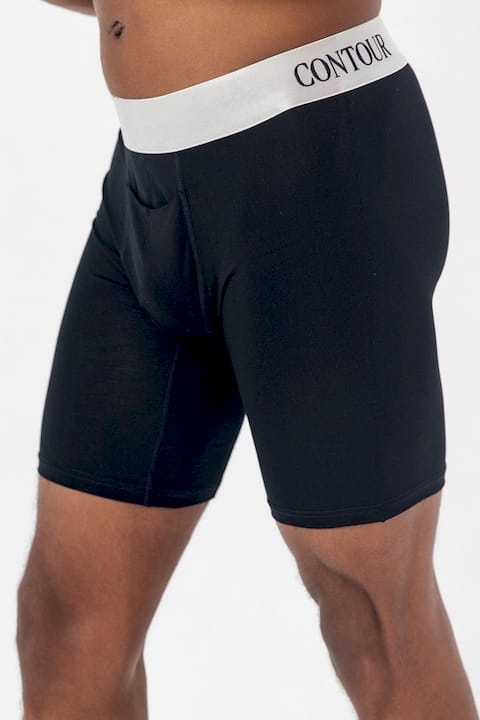
A few red flags tell you it’s time to switch styles or sizes. If you’re constantly reaching down to pull fabric back into place, that’s a ride-up problem, usually solved by moving to a longer inseam or a brand with a non-rising leg construction. If you see a visible line under fitted pants no matter what you do, that’s a silhouette problem, usually solved by sizing down or switching to trunks. If the waistband leaves a red mark by midday, that’s a sizing problem, not a style problem, and no amount of switching cuts will fix it.
What Fabric and Pouch Design Should You Check For?
Fabric determines whether either cut actually feels good against skin for a full day, and this is where a lot of cheap underwear falls apart regardless of whether it’s a trunk or a boxer brief.
Cotton breathes well and feels familiar, but it holds moisture and loses shape faster than blended fabrics, especially after repeated washing. Modal and other viscose blends drape closer to the body, wick moisture better than straight cotton, and tend to resist the sagging that makes older underwear feel loose in the wrong places. Synthetic blends with added spandex or elastane bring stretch and recovery, which matters most for boxer briefs since that longer leg fabric needs to move with you instead of twisting.
The pouch is the detail most buyers skip past on a product listing, and it shouldn’t be. A shaped, contoured pouch reduces midday adjusting far more than leg length does, and it interacts directly with the cut: a boxer brief with a flat, unshaped pouch will feel more restrictive than a trunk with a properly shaped one, regardless of how much thigh coverage either one offers.
Construction details separate a pair that survives a hundred washes from one that stretches out in a month:
- Leg hem design matters most for ride-up. A bonded or laser-cut hem that doesn’t rely on gripping elastic tends to stay in place better than a traditional sewn hem, particularly on boxer briefs where the hem sits mid-thigh.
- Elastic waistband width affects both comfort and how long a pair holds its shape. Wider bands (roughly 1 to 1.5 inches) distribute pressure better than thin bands, which dig in and roll.
- Fabric weight determines breathability. Lighter, four-way stretch fabric moves heat away from skin faster than heavier cotton blends, which matters in humid climates or during exercise.
Cleveland Clinic’s chafing guidance also flags that moisture buildup accelerates friction damage, which is a practical argument for breathable, moisture-wicking fabric over heavier cotton, independent of which cut you choose. A boxer brief made from a fabric that traps sweat can still chafe, even with full thigh coverage. The cut reduces skin-to-skin contact; the fabric determines whether that contact stays dry.
How Do You Measure and Size Trunks or Boxer Briefs Correctly?
Sizing charts fail more often on fit complaints than the actual cut does. Get three measurements before you buy: waist circumference at the point you naturally wear your pants, hip circumference at the widest point, and thigh circumference about an inch below the base of your glutes. Most size charts weight waist and hip more heavily, but thigh measurement matters more for boxer briefs than trunks, since that longer leg has more direct contact with skin.
Once you’re wearing a pair, run through this checklist before deciding it fits:
- Waistband: it should sit flat against skin without digging in or rolling over, even after sitting for ten minutes.
- Leg opening position: on boxer briefs, the hem should land above the knee with no gripping or riding up; on trunks, it should sit flush against the upper thigh without flapping loose.
- Pouch support: there should be enough room to move without feeling loose or compressed; a pouch that flattens under regular pants is too small.
- No pinching at the inseam: if you feel a seam dragging when you walk, size up regardless of what the waist measurement suggested.
If you’re between two sizes, the rule flips depending on the cut. For trunks, size down slightly, since the shorter leg and squarer fit benefit from a snugger hold that won’t slide. For boxer briefs, size up slightly, since a longer leg with too little stretch is what causes bunching behind the knee. Wearcontour’s size guide walks through exact waist and hip ranges if you want to double check a specific pair before ordering.
Where Did Boxer Briefs and Trunks Actually Come From?
Boxer briefs showed up in the late 1980s as a direct answer to a real complaint: guys who liked the support of briefs but wanted the coverage of boxer shorts. The hybrid caught on fast, helped along by underwear ad campaigns that turned the category into a genuine fashion statement rather than something hidden under clothes.
Trunks came later, arriving in the 2000s as brands started shortening the boxer brief’s leg to create something that felt more like a fitted boxer short. The goal was a squarer, gym-ready silhouette that worked better under slim pants, which were becoming the dominant men’s fashion trend around the same time. Trunks essentially borrowed the boxer brief’s fitted waist and support while cutting the leg length down for a lower-profile look.
Both styles now sit as permanent fixtures in men’s underwear drawers, and the split between them tracks almost exactly with the split in men’s pants: as fitted, tapered trousers became mainstream, trunks grew alongside them; as athletic and athleisure wear expanded, boxer briefs kept their footing as the more functional, movement-friendly choice. Neither style replaced the other. They settled into different jobs.
Do Boxer Briefs or Trunks Hold Up Better Over Time?
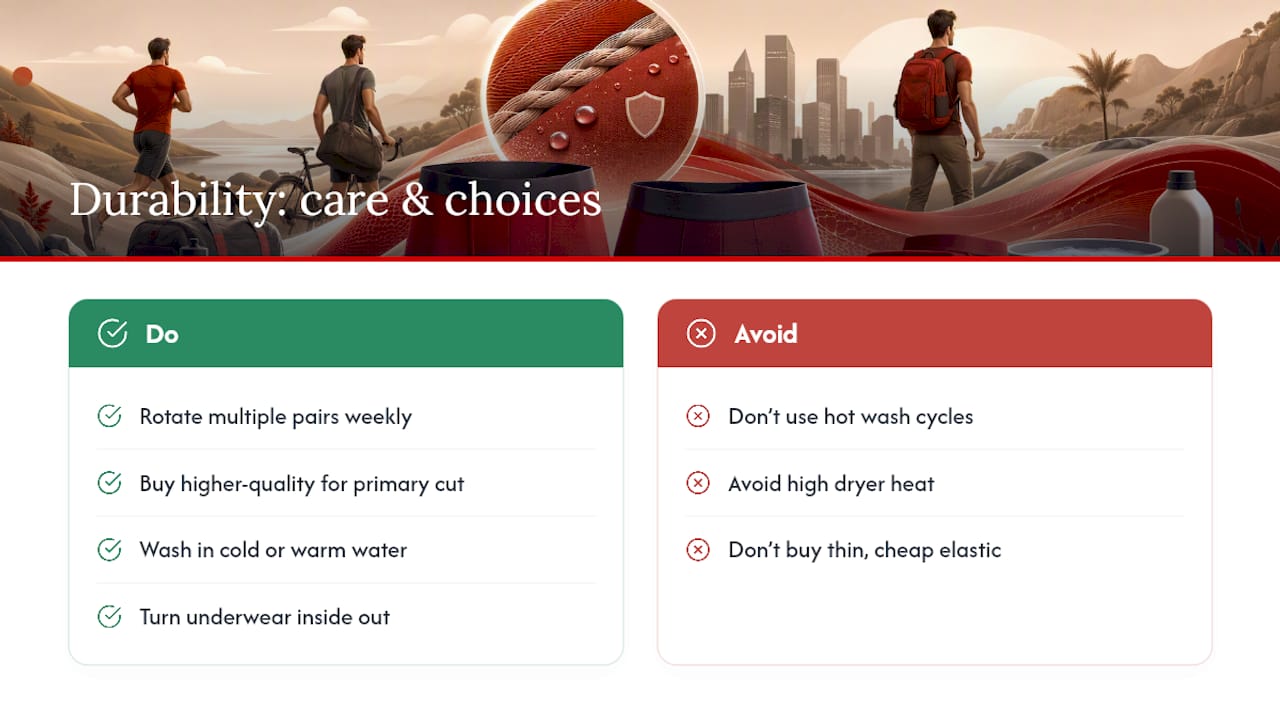
Longevity comes down to fabric and construction far more than cut, but there’s one durability difference worth knowing: boxer briefs cover more surface area, so the fabric in the leg panels takes more repeated stretch and friction from thigh movement over the life of the garment. Cheaper cotton boxer briefs tend to show wear, sagging, or thinning in that leg panel before a trunk made from the same fabric would, simply because there’s more fabric doing more work.
Elastic waistbands degrade the same way on both cuts, and that’s usually the first failure point regardless of style. A wider, higher-quality band resists losing its snap through repeated washing, while a thin, cheap elastic starts rolling or losing grip within a few months of regular wear.
Care habits matter more than most guys assume. Washing in cold or warm water rather than hot preserves elastic longer, and skipping the dryer’s high heat setting (or skipping the dryer altogether) prevents the fabric from losing its stretch prematurely. Turning underwear inside out before washing reduces pilling on the outer surface, which matters for fabric that gets visible wear like a trunk’s exposed leg hem.
If you’re buying multiple pairs to rotate through the week, spend slightly more on the ones that touch your skin the most, meaning boxer briefs if that’s your primary cut. The stretch and recovery in a well-built four-way stretch fabric holds its shape through more wash cycles than a basic cotton blend, and that difference shows up as the months go by, not on day one.
Wearcontour’s Perspective: Why Fit Complaints Usually Come Down to Construction
Most of the frustration guys describe with underwear, the constant adjusting, the fabric climbing up a thigh, the visible line under dress pants, isn’t really a trunks-versus-boxer-briefs problem. It’s a construction problem that happens to show up more in one cut than the other.
That’s the reasoning behind the Contour™ Signature Boxer Brief’s non-rising leg design: if the leg hem doesn’t grip and climb in the first place, you get the coverage benefits of a longer inseam without the ride-up that makes some guys avoid boxer briefs entirely. The tagless construction and four-way stretch fabric solve a related complaint, the itching and restriction that make guys reach for a trunk out of habit rather than actual preference.
None of this means boxer briefs are the right call for every guy reading this. It means that if you’ve ruled out boxer briefs because of bunching or visible lines, the cut probably wasn’t the actual problem.
— Tim
A Boxer Brief Built for the Coverage-First Guy
If everything above points you toward boxer briefs, the next question is which pair actually delivers on the coverage-without-hassle promise. The Contour™ Signature Boxer Brief is built specifically for guys who want the chafe protection and thigh coverage of a longer inseam without the trade-off of constant readjusting.
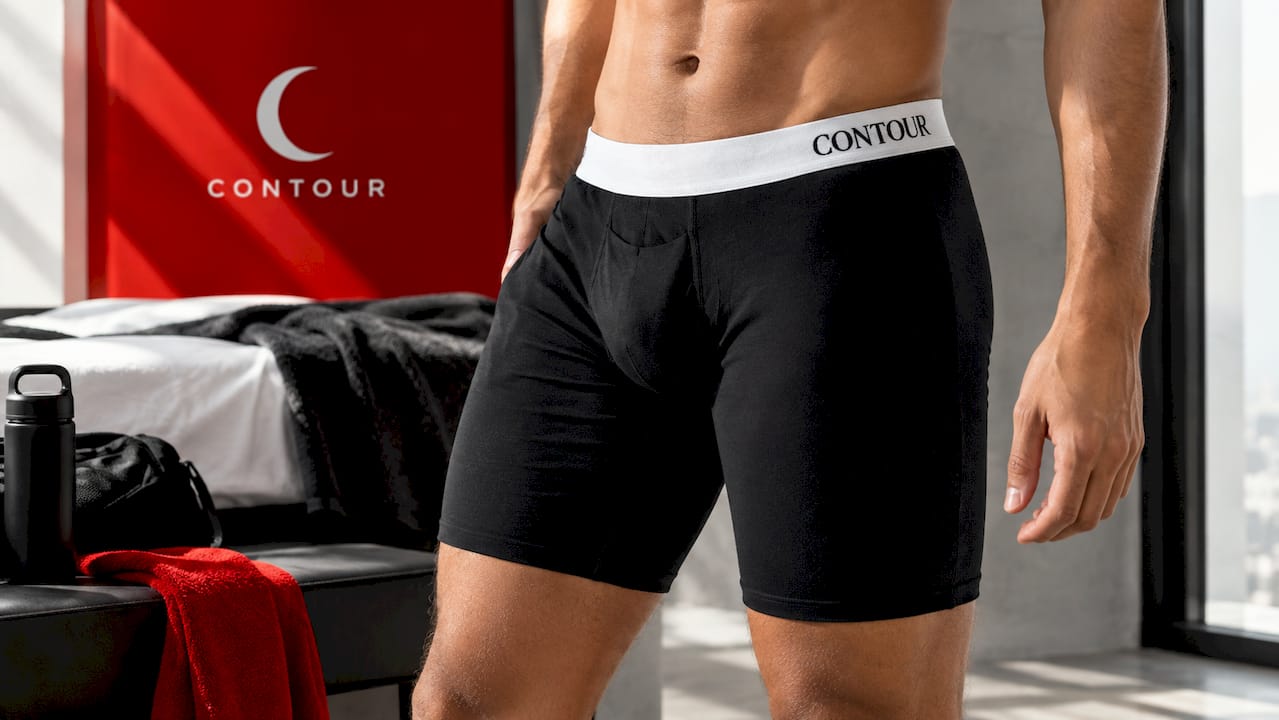
The non-rising leg construction keeps the hem in place through squats, long walks, and full days at a desk, so the coverage benefit doesn’t come with a ride-up penalty. The tagless design removes the one spot on most underwear that irritates skin by the end of the day, and the breathable, four-way stretch fabric is built to hold its shape and softness through repeated washing rather than sagging out after a few months. It’s the practical answer for anyone who read the chafing section above and thought, “yeah, that’s me.” Check sizing against the guide, then grab a pair of the Contour™ Signature Boxer Brief and see how a non-rising leg actually feels through a full day.
Sources
FAQ
Which Is Better, Trunks or Boxer Briefs?
Neither wins outright. Trunks fit better under tailored, slim pants and feel less bulky during flexible movement, while boxer briefs give more thigh coverage and hold up better against chafing during running, cycling, or long days on your feet.
Are Men’s Trunks the Same as Boxer Briefs?
No. Trunks have a shorter inseam and a squarer leg opening, while boxer briefs run longer with a more tapered fit that covers more of the thigh.
Do Women Prefer Trunks or Boxer Briefs on Men?
There’s no reliable data on this, and preferences vary too much person to generalize. Fit and confidence in what you’re wearing matter more than the specific cut.
What Do the British Call a Bra?
In British English, “bra” is standard, the same as in American English; it’s short for “brassiere” in both dialects and isn’t a term that differs by region.
Are Trunks Comfortable for Everyday Wear?
Yes, particularly for slimmer builds or anyone wearing fitted pants, since the shorter leg reduces bulk. Guys with thicker thighs or high-movement jobs often find boxer briefs, including options like the Contour™ Signature Boxer Brief, more comfortable across a full day.